Trinity, FL — Community Intelligence Hub | The Blue Collar Realtor
Family Community Match  ·  Northern Pasco Corridor

Trinity, FL
Community Infrastructure
Built for the Long Hold.

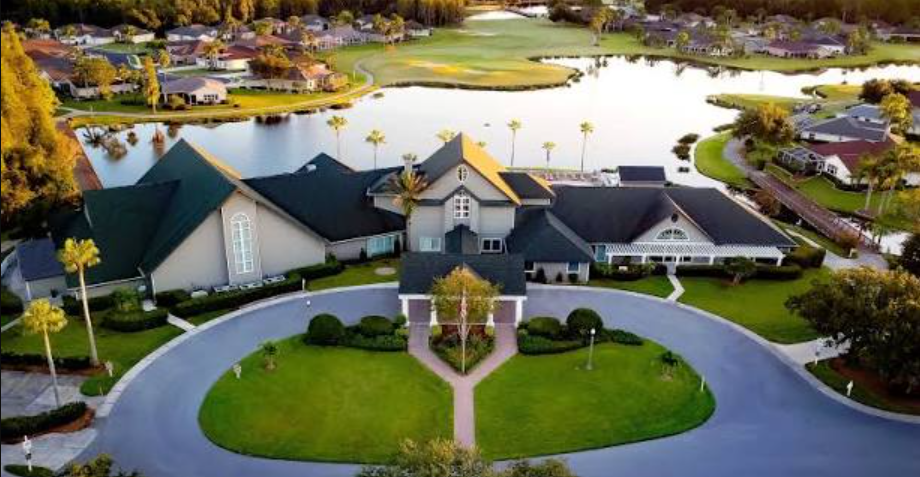
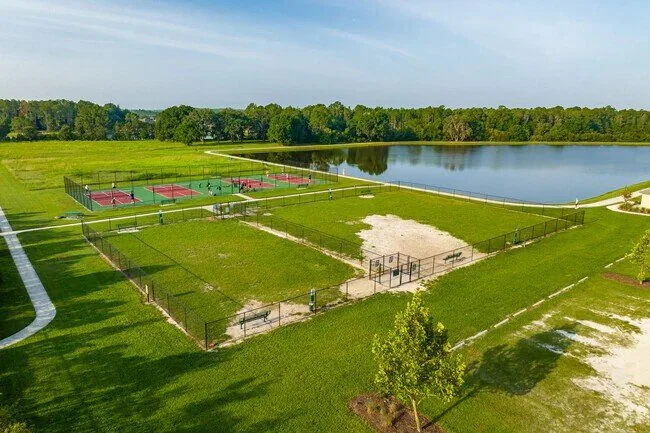
Established neighborhoods. Strong school zones. Walkable amenities and a SR 54 retail corridor that removes the friction from daily life. If you are entering the northern Pasco market in the $350K–$650K tier, Trinity is where the analysis starts.

Market Intelligence

Trinity Is One of Pasco County's Most Consistent Resale Markets.

Trinity does not produce the headline appreciation numbers of newer master-planned communities, nor does it need to. Its value proposition is stability — strong school zones, established community infrastructure, and a buyer pool deep enough to support consistent resale demand across market cycles.

$468K Median List Price
(2026 Baseline)
34 Avg Days
on Market
Zone X Flood Zone
Designation (primary)
A / A+ School Rating
Profile

Buyer Demand Profile

Growing families relocating from Hillsborough County for school access and price point, military households from the MacDill pipeline seeking value at the $400K–$600K tier, and move-up buyers from New Port Richey and Port Richey moving into a higher-amenity corridor. Remote-work professionals drawn by commute flexibility and community infrastructure are an increasingly visible segment.

Inventory Character

Predominantly single-family homes in established gated and non-gated communities built primarily between 1998 and 2015. Lot sizes range from 0.15 to 0.35 acres — larger than newer master-planned communities but smaller than Odessa or Keystone. Limited new construction within Trinity proper; most new inventory is being absorbed in adjacent Fox Wood, Longleaf, and Villages of Fox Hollow. Move-in-ready resale is the primary transaction type.

Ownership Duration Trend

Trinity sellers typically hold 6–10 years — longer than Pasco's newer communities but shorter than Keystone or Odessa's estate segment. The dominant exit trigger is lifecycle change: school completion, family growth requiring more space, or income growth enabling a move to the $650K–$900K tier in Odessa. Rate-lock psychology is a meaningful factor in Trinity — a significant share of owners carry sub-4% mortgages from 2020–2022 purchases.

Neighborhood Spotlight

Trinity's Communities Each Serve a Different Ownership Profile.

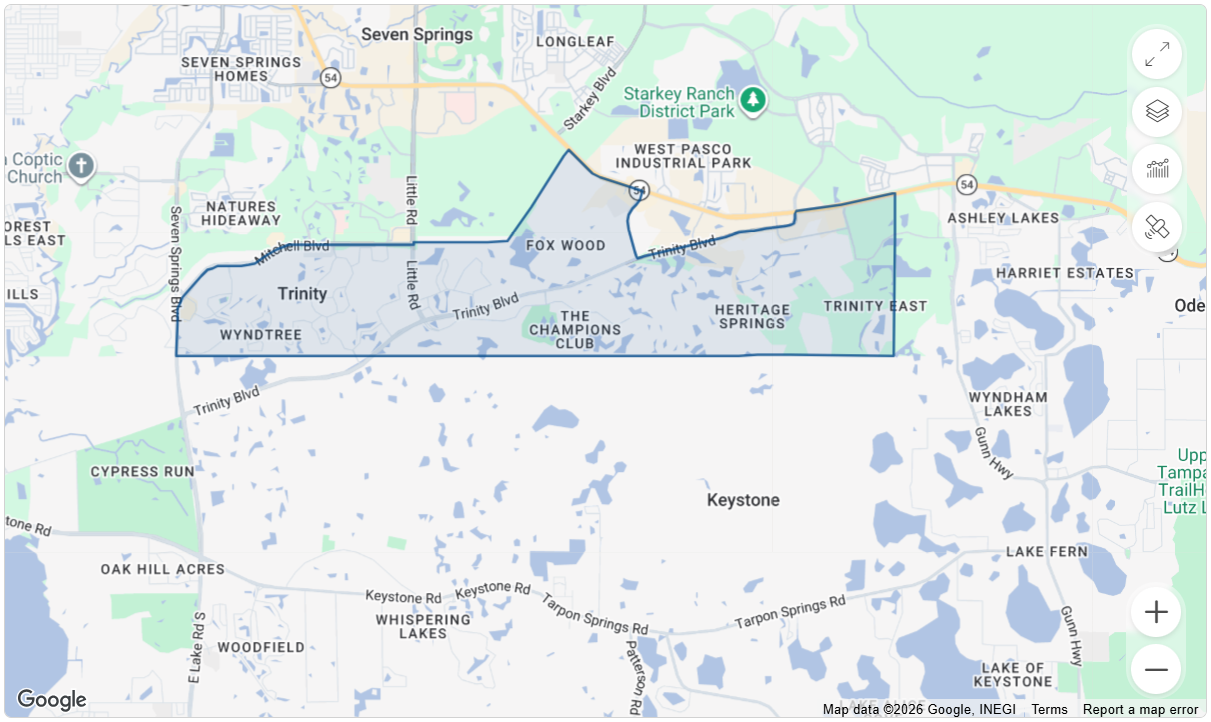
Trinity is not a single subdivision — it is a collection of distinct communities clustered around the SR 54 corridor. Price floor, HOA structure, school assignment, and lifestyle character vary meaningfully across the area.

Fox Wood Trinity
Gated & Established

Fox Wood & Seven Oaks

Gated communities with mature landscaping, community amenities, and strong HOA governance. Price range $420K–$620K. One of Trinity's most recognizable and consistently demanded addresses. Trinity Elementary and J.W. Mitchell High School zone. HOA fees typically $150–$280/month. No CDD in most phases.

Longleaf Trinity
New Urbanism Design

Longleaf

New Urbanist-designed community with front-porch architecture, walkable streets, community pool, and a town center model. Townhomes and single-family homes from $350K–$530K. Strong community identity and unusually high walkability for a Pasco corridor community. CDD assessment applies — verify current annual amount via estoppel before offer.

Villages of Fox Hollow Trinity
Value & Access

Villages of Fox Hollow & Heritage Springs

More accessible price points ($340K–$480K) with established neighborhood character. Heritage Springs is an active-adult community (55+) — confirm age restriction eligibility if applicable. Fox Hollow offers larger lot proportions relative to price within the Trinity corridor. Both sit within strong school zone positioning for J.W. Mitchell and Seven Springs Middle.

Trinity new construction
Move-Up & New Construction

Rettinger Road & Trinity East Corridor

Newer construction phases and custom-build lots east of Little Road. Single-family homes $470K–$680K on larger lots. Less established community character but higher ceiling on home size and customization. CDD assessments active in newer phases — factor into full ownership cost model. Growing retail and healthcare access along SR 54 benefits this corridor directly.

School Zone Intelligence

Trinity's Schools Are the Primary Reason Families Choose This Corridor.

Within Pasco County, Trinity's school zone profile is among the strongest in the district. J.W. Mitchell High School consistently performs at the top of the county's public school rankings. This rating premium is reflected directly in Trinity's home values relative to comparable inventory in adjacent zip codes — and it is the primary driver of resale demand when Trinity owners eventually list.

Level School Rating Notes
Elementary Trinity Elementary A-Rated Serves core Trinity communities including Fox Wood and Seven Oaks. Consistently high performance. Strong parental involvement culture.
Elementary Longleaf Elementary A-Rated Serves Longleaf and adjacent communities. Co-located with the Longleaf neighborhood — walkable for residents. Smaller enrollment, community-oriented character.
Elementary Odessa Elementary A-Rated Serves some eastern Trinity and Fox Hollow parcels depending on address. Verify assignment against specific address before offer.
Middle Seven Springs Middle A-Rated Primary middle school for Trinity corridor. Consistent academic performance. Strong arts and athletics programs.
Middle Paul R. Smith Middle B-Rated Serves portions of the western Trinity and Fox Hollow corridor. Verify by specific address — assignment varies within Trinity ZIP codes.
High School J.W. Mitchell High School A-Rated The primary value driver in Trinity real estate. Top-performing Pasco County public high school. Strong AP program, JROTC, and athletics. Buyer premium for Mitchell zone is documented and consistent — homes in zone command 6–10% above comparable out-of-zone inventory.

Charter & Private Alternatives

  • Plato Academy Charter School — Trinity campus, K–8
  • Classical Preparatory School — nearby corridor, classical education model
  • Academy at the Lakes — Land O' Lakes, highly regarded independent school
  • Pasco eSchool — full-time virtual option within Pasco County Schools

The Mitchell Premium — What It Means for Buyers and Sellers

J.W. Mitchell zone assignment is a documented resale premium in Trinity. For buyers, this means you are paying for the zone — and that premium is justified by both current quality and consistent demand. For sellers, it means your school zone is an active marketing asset that should be featured, verified, and prominently disclosed in every listing. Always run the specific address through the Pasco County Schools finder before offer submission.

Insurance & Capital Exposure

Trinity's Insurance Profile Is Manageable — With the Right Pre-Offer Work.

Trinity sits inland and primarily in Zone X — a favorable starting position relative to coastal Pasco communities. However, the most common capital surprise for Trinity buyers is not insurance. It is CDD assessments that were not fully disclosed, understood, or factored into the ownership cost model before closing.

CDD Assessment Alert: Community Development Districts are present in several Trinity communities — including Longleaf, portions of the eastern Trinity corridor, and some newer phases of Fox Hollow. CDD assessments are a non-optional annual charge collected as part of your property tax bill. They are not HOA fees and cannot be negotiated away at closing. Always request the current CDD annual assessment amount, the outstanding CDD bond balance, and the estimated payoff timeline via the current HOA estoppel and seller disclosures before submitting an offer. CDD assessments in this corridor typically run $800–$2,200 annually.

Flood Zone
The majority of Trinity is designated Zone X (minimal flood hazard). Pockets near retention ponds and drainage easements in some communities carry AH designations — verify the specific parcel via FEMA FIRM map lookup before offer. Flood insurance is generally not required but can be advisable on pond-adjacent lots during particularly active storm seasons.
Wind / Hurricane
Trinity's inland position limits wind exposure significantly relative to coastal Pasco and Pinellas. Roof age remains the primary premium variable. Homes built between 2002 and 2010 under updated Florida Building Code standards typically carry better wind mitigation profiles than pre-2002 construction. Request wind mitigation inspection documentation from the seller as a standard disclosure item — it directly affects insurance pricing and transferability of existing policies.
Homeowners Premium Range
Well-maintained Trinity homes with roofs under 10 years old and Zone X designation: $2,800–$4,800 annually from admitted carriers. Homes with roofs approaching 15 years or prior claims history: $4,500–$7,200 annually. Trinity's price tier keeps most properties within Citizens Insurance eligibility thresholds, which provides more competitive rate options than are available in Odessa or Keystone's higher-value tiers.
HOA Fees
HOA fees vary by community: Fox Wood and Seven Oaks $150–$280/month; Longleaf $120–$195/month; Villages of Fox Hollow $60–$120/quarter; Heritage Springs $200–$310/month (active adult, includes amenity package). Always verify current fees and reserve fund status via current estoppel — underfunded HOA reserves are a leading indicator of future special assessments.
CDD Assessment
Where applicable: $800–$2,200 annually collected via property tax bill. CDD bond balances may extend 10–25 years depending on community age and original bond structure. Newer phases carry higher outstanding balances and longer payoff timelines. This is a non-negotiable recurring cost — it must be factored into monthly ownership modeling before offer submission, not discovered at closing.
Property Tax (2026)
Pasco County millage produces effective rates of approximately 0.95%–1.2% of assessed value annually — generally more favorable than Hillsborough County at comparable price points. A $468K Trinity home carries estimated annual taxes of $4,450–$5,600 before Homestead Exemption. Homestead provides a $50,000 assessed value reduction plus Save Our Homes appreciation cap for owner-occupants. File before March 1 of the year following purchase.
5-Year Carry Cost
Full ownership model for a $468K Trinity home at 6.8% / 30-year: estimated $3,060/month PITI + $280–$430/month insurance + $150–$280/month HOA + $80–$180/month CDD (where applicable) + 1% annual maintenance reserve. Total ownership run rate: $4,400–$5,600/month depending on community and property specifics. Materially more accessible than Odessa or Keystone at equivalent life stage — which is precisely the buyer this community serves.

Blue Collar Standard: The Full Ownership Cost Model

In Trinity specifically, the pre-offer checklist includes CDD balance verification, HOA reserve fund status, roof age documentation, and insurance pre-quote — in that order. Most buyer surprises in this market are not market surprises. They are disclosure gaps. The Blue Collar Realtor closes those gaps before contract, not during escrow.

Hub Architecture

Each Community Hub Is Built Like a Local Ownership Encyclopedia.

Community Intelligence

Neighborhood context, ownership patterns, school-zone demand, infrastructure history, growth pressure, and community positioning.

Property Intelligence

Roof age, HVAC lifecycle, insurance exposure, maintenance burden, acreage considerations, taxes, and 5-year carry cost analysis.

Decision Intelligence

Equity position, transition timing, downsizing scenarios, buyer demand, seller leverage, and long-term ownership strategy.

Every flagship hub contains

  • Market overview and buyer demand profile
  • Ownership duration and lifecycle trends
  • Insurance pressure and capital exposure analysis
  • Property tax and maintenance cost considerations
  • School zones, infrastructure, and community history
  • Equity, lifestyle transition, and downsizing analysis
  • FAQ library, reports, videos, and related assessments
Frequently Asked Questions

What Trinity Buyers and Sellers Ask Most.

A Community Development District is a special-purpose local government created to finance and manage infrastructure in planned communities — roads, utilities, drainage, amenities. The developer issues bonds to fund that infrastructure, and those bonds are repaid by property owners over time through an annual assessment collected alongside your property taxes.

In practical terms: if you purchase in a CDD community in Trinity, you will see a line item on your annual property tax bill for the CDD assessment. It is not optional, it does not go away at closing, and it does not disappear when the HOA tells you the amenities are paid off. The bond has a separate payoff timeline — sometimes 15 to 25 years from the community's initial development. Newer phases of Trinity communities carry higher outstanding balances. This is a real cost that belongs in your monthly ownership model before you make an offer, and it is one of the most commonly under-disclosed items in this market.

The premium is real and it is documented in resale data. Homes in the J.W. Mitchell zone in Trinity consistently sell at 6–10% above comparable inventory in adjacent Pasco zip codes outside the zone. That spread has held across multiple market cycles, which suggests it is structural rather than cyclical.

Whether it is worth it depends on your household's situation. If you have school-age children and the school quality matters to your family's quality of life during the hold period — and you anticipate selling when those children complete school — you are essentially leasing the zone premium and recovering it at resale. If you are purchasing as an investor, the zone drives rental demand from families who want the school access without buying. If you have no children and no resale horizon that aligns with school demographics, the premium is mostly a safety net, not an active benefit. It is still generally worth having — but it is worth understanding what you are actually buying.

Both are viable on a MacDill BAH budget at the O-4 to O-5 tier in 2026, and the practical differences come down to commute and community preference. Trinity sits further west — the SR 54 to Veterans Expressway to I-275 route to MacDill runs 40–55 minutes depending on time of day. Land O' Lakes is slightly further east but the I-75 corridor and SR 56 connection offers an alternative routing.

Trinity's advantage is community density — more walkable, more established retail and healthcare infrastructure on SR 54, and a slightly more uniform neighborhood character. Land O' Lakes offers newer construction options and more varied lot sizes at comparable price points, plus lakefront access in some areas. If school zone is the primary decision variable, Trinity's J.W. Mitchell profile is slightly more consistent than Land O' Lakes' more varied school assignment landscape. If new construction and lot flexibility matter more, Land O' Lakes competes well. A site visit to both, with school zone verification on specific addresses, is the right approach before committing to either corridor.

This is the central question for a large cohort of Trinity owners in 2026, and the math is more nuanced than the rate-lock narrative suggests. The question is not whether your rate is 3.1% — it is what your deployable equity position looks like, what your next property costs, and whether the life circumstances driving the consideration are strong enough to justify the transition cost.

If you purchased a $380K Trinity home in 2021 at 3.1%, your current estimated equity — accounting for appreciation and principal paydown — could be in the range of $120K–$180K depending on purchase price and down payment. That is a meaningful down payment on a $600K–$750K Odessa or Keystone property. Your new rate on that purchase will be higher — but the equity from Trinity funds a larger down payment, which reduces the loan balance and partially offsets the rate differential. An equity orientation session models this specific scenario with your actual numbers. That is where the conversation should start, not at a listing presentation.

Three items are consistently under-scrutinized in Trinity resale transactions. First, HVAC system age and service history. Trinity's dominant build era (2000–2012) means a meaningful share of HVAC systems are approaching or past expected service life of 15–18 years for Florida conditions. Replacement runs $6,000–$12,000 depending on system size and efficiency tier. Ask for service records and have your inspector confirm refrigerant type — R-22 systems are expensive to service and increasingly difficult to maintain.

Second, roof condition and wind mitigation documentation. A roof approaching 15 years in Florida is entering the insurance scrutiny window. Obtain a 4-point inspection in addition to the standard home inspection — it evaluates roof, HVAC, plumbing, and electrical specifically for insurance underwriting purposes. Third, drainage and retention pond proximity. Trinity's flat topography means drainage management matters. Lots adjacent to retention ponds may have deed-restricted buffer zones limiting improvement options, and some ponds are HOA-maintained, which means your HOA fee partially funds their management. Understand the pond's functional role and the HOA's maintenance obligations before closing.

Longleaf is one of the more genuinely executed New Urbanist communities in the Tampa Bay market — the front-porch architecture, alley-loaded garages, walkable streets, and co-located elementary school are not just marketing language. Residents who prioritize walkability, community interaction, and neighborhood density tend to stay longer and express higher satisfaction than the Trinity average. The community has a distinct identity that other Trinity neighborhoods do not replicate.

The considerations are practical rather than conceptual. CDD assessments apply and should be verified. Lot sizes are smaller than Fox Wood or the eastern corridor — this is by design, not a compromise. Townhome and single-family options occupy the same streetscape, which some buyers embrace and others find constraining. Resale demand is consistent for buyers who sought Longleaf specifically — but the universe of buyers who self-select into the New Urbanist model is smaller than the mainstream Trinity buyer pool. That is a liquidity consideration, not a quality concern. If the lifestyle matches your household, the fundamentals support the decision.

Request a Community Briefing

The First Conversation Is About Your Situation, Not a Sale.

Whether you are evaluating Trinity as a buyer, trying to understand your equity position as a current owner, or modeling a move-up scenario from Trinity to Odessa or Keystone, the starting point is a direct conversation about your actual numbers. No urgency. No pitch. Just clarity.

This is not a listing appointment. It is a clarity conversation. Josh Porthouse · The Blue Collar Realtor · Compass Florida, LLC · (727) 287-7815 · JoshPorthouse.com · Information provided is for educational purposes and does not constitute legal, financial, or real estate advice. All figures should be independently verified. CDD assessments, HOA fees, school assignments, and flood zone designations must be confirmed with the applicable governing authority prior to any real estate decision.

The Blue Collar Realtor™  ·  Josh Porthouse, Licensed Florida Realtor  ·  Compass Florida, LLC  ·  (727) 287-7815  ·  JoshPorthouse.com
Guidance Built on Character. Decisions Built to Last.  ·  Information provided for educational purposes only. All market data, insurance figures, tax estimates, CDD assessments, HOA fees, and school assignments should be independently verified prior to any real estate decision.